Digital Livelihoods Insights
Digital Livelihoods in Jordan: From Learning to Verified Economic Participation
Jul 23, 2026
|
0
Written by Aows Dargazali and Wafa Aladwan
Director – Development & Capacity Building Programmes, UniHouse Global | Founder of Ostathi • Managing Director, UniHouse Jordan
An analytical review of the global digital labour market, the structural constraints shaping the Middle East's participation in it, and the infrastructure required to move young Jordanians from learning into measurable economic participation — with evidence from the current implementation in Jordan.
On this page
The global shift in how work is accessed
Work is increasingly found, contracted, delivered, and paid for through digital channels. The World Bank estimates that between 154 million and 435 million people worldwide now perform online gig work — between 4.4 and 12.5 per cent of the global labour force (World Bank, 2023). Demand for this work grew by 41 per cent between 2016 and the first quarter of 2023, and low- and middle-income countries now account for 40 per cent of traffic to gig platforms (World Bank, 2023).
For governments and development institutions in the Middle East, the question this raises is no longer whether digitally enabled work matters to employment policy. Over half of online gig workers worldwide are young people (World Bank, 2023) — and no region has higher youth unemployment than the Middle East. The question is why access has not converted into income — and what infrastructure is required for it to do so.
Jordan poses the problem in its sharpest form. Internet penetration stands at 92.5 per cent (DataReportal, 2025), yet youth unemployment is roughly three times the global average. Connectivity, in other words, is necessary but not sufficient. This article examines what the global evidence says about the missing layer between digital access and digital income — and how that layer is being built in Jordan.
What is a digital livelihood?
A digital livelihood is sustained, verifiable income earned through digitally enabled work — remote employment, online freelancing, platform-mediated services, digital entrepreneurship, or digitally delivered professional services. It is not the same as completing a digital course. A course produces a certificate; a livelihood requires market-relevant competencies, a credible professional identity, access to clients, workable payment channels, and income that continues and grows over time. The distance between the two is the central subject of this article.
Definitions matter, because different forms of digitally enabled work behave differently and are measured differently. The International Labour Organization distinguishes online web-based platform work, performed remotely for clients anywhere, from location-based platform work such as ride-hailing and delivery, performed at a physical location (ILO, 2021). The OECD, ILO, and European Commission have published a joint measurement framework to keep these categories statistically distinct (OECD/ILO/EC, 2023). Table 1 summarises the forms of work this article covers — figures cited for one category should not be read as describing the others.
Table 1. Forms of digitally enabled work — distinct categories, distinct measurement
| Form of work | What it is | Measurement note |
|---|---|---|
| Remote employment | A conventional employment contract performed remotely for a single employer | Captured in national labour force surveys |
| Online freelancing | Project-based professional services sold remotely to multiple clients, often via web-based platforms | Partially visible; tracked by platform data and the Online Labour Index |
| Platform-mediated (location-based) work | Ride-hailing, delivery, and similar work matched digitally but performed locally | Distinct economics; excluded from online-work figures here |
| Digital entrepreneurship | Building a digitally delivered business with its own clients and products | Captured in enterprise and MSME statistics |
| Digitally delivered professional services | Tutoring, translation, design, accounting, and similar services delivered online | The primary category for Jordan's accessible occupations |
| Local gig work | Short-term local tasks matched through apps | Local labour market; not cross-border |
| Global digital labour participation | Cross-border participation in the categories above | The 154–435 million World Bank estimate covers online gig work only |
Global digital labour-market trends
Scale, growth, and measurability
Three structural facts define the current market. First, scale: the number of digital labour platforms grew from 142 in 2010 to over 777 in 2020, with platform revenue reaching at least US$52 billion in 2019 (ILO, 2021). Second, distribution: 545 online gig platforms now operate across 186 countries, and roughly three-quarters of them are regional or local rather than global — platforms that adapt to local languages, labour markets, and payment constraints (World Bank, 2023). Third, measurability: instruments such as the Online Labour Index, developed at the Oxford Internet Institute and maintained with the ILO, now track online freelance supply and demand across countries and occupations in near real time (Oxford Internet Institute). Online work can be counted, priced, and verified — which means programme outcomes in this market can be too.
The evidence also carries a warning. Half of online platform workers earn less than US$2 per hour (ILO, 2021), and the ILO has cautioned that workers absorbed into gig and data work without support face poorer working conditions and fewer prospects of occupational progression (ILO, 2025). Platform work is now on the agenda of the International Labour Conference's standard-setting process (ILO, 2024). Digital work does not automatically produce a decent livelihood; unstructured exposure to it can entrench precarity.
What the market buys
Demand is project-based and flexible: writing and translation, digital marketing, administrative support, design, data services, software, and professional services such as tutoring and accounting. It is also geographically concentrated — high-income countries generate 77.2 per cent of global demand for online gig work, with the United States alone accounting for 36.8 per cent (World Bank, 2023). A worker in Amman competes with workers everywhere. That competition rewards exactly the assets most conventional programmes do not build: a verified track record, a discoverable professional profile, defined services, and credible pricing.
Generative AI is reshaping the entry rungs
Generative AI changes the composition of this demand. The ILO estimates that one in four workers worldwide is in an occupation with some exposure to generative AI, with clerical work the most exposed category — and, because of the composition of clerical employment, the share of women's employment in the most exposed tier is roughly twice that of men's (ILO, 2025; ILO, 2023). The ILO's central finding is transformation rather than elimination: most exposed jobs will change, not disappear. The IMF reaches a similar aggregate conclusion, estimating that almost 40 per cent of global employment is exposed to AI (IMF, 2024).
At platform level the effect is already measurable. After the release of ChatGPT, freelancers in writing-exposed occupations on a major online labour market saw monthly jobs fall by 2 per cent and monthly earnings by 5.2 per cent (Hui, Reshef and Zhou, 2023), while client postings for automation-prone writing and coding tasks fell by 21 per cent (Demirci, Hannane and Zhu, 2023). The lowest rungs of online work — generic writing, routine formatting, undifferentiated microtasks — are precisely the rungs being compressed. The World Bank's assessment of what developing economies need to capture AI-era digital opportunity emphasises foundations: connectivity, computing capacity, data in local context, and human competency (World Bank, 2025).
The implication for livelihood programming is direct. Occupational selection must be market-led and revisited continuously; AI tools must be embedded within capability development rather than treated as a threat to it; and the premium shifts to what AI cannot supply — verified human competency, local and bilingual context, client relationships, and a track record that can be checked. Table 2 draws these threads together.
Table 2. From global trend to implementation response
| Global trend | Evidence | Implication for the Middle East | Implication for Jordan | Implementation response |
|---|---|---|---|---|
| Online work at labour-force scale | 154–435m online gig workers; demand +41% since 2016 (World Bank, 2023) | A participation channel where formal job creation lags | An addressable market for educated, connected youth | Structured pathways from outreach to income, not stand-alone courses |
| Rise of regional and local platforms | ~75% of 545 platforms are regional/local (World Bank, 2023) | Local platforms can fit local payment and language constraints | A national, Arabic-first platform is viable infrastructure | Deploy country-level delivery ecosystems, locally contextualised |
| Demand concentrated in high-income markets | 77.2% of demand from high-income countries (World Bank, 2023) | MENA suppliers compete globally on quality and trust | Differentiation through verification and bilingual services | Professional profiles, portfolios, and verifiable credentials |
| Generative AI compresses routine gigs | Writing-exposed earnings −5.2%; automation-prone postings −21% (2023) | Entry rungs narrowing; clerical tasks most exposed | Beginner occupations must be selected dynamically | Market-led occupational analysis; AI tools embedded in delivery |
| Online work is measurable | Online Labour Index; platform transaction data | Outcomes can be verified, not self-reported | Income outcomes can anchor national programmes | Measurement architecture from baseline to 12-month income tracking |
The Middle East: opportunity and structural constraints
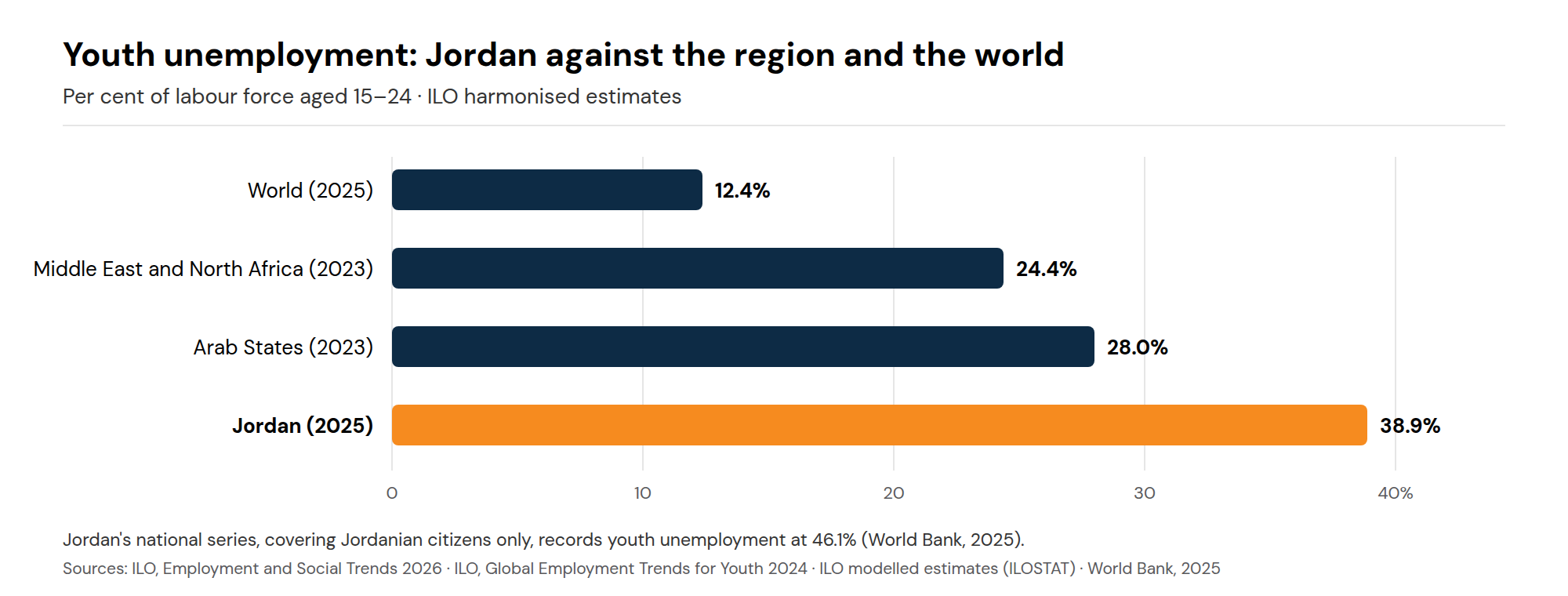
The Middle East and North Africa enters this market with the world's most acute youth employment problem and one of its clearest reasons to solve it digitally. Youth unemployment in the region stood at 24.4 per cent in 2023 — the highest of any region and roughly double the global average of 13.0 per cent — and higher still, at 28.0 per cent, in the Arab States (ILO, 2024). Among young women the exclusion is deeper still: 44.2 per cent of young women in the region were not in employment, education, or training in 2023, more than double the rate for young men (ILO, 2024). Female labour force participation, at 19.7 per cent, is the lowest of any world region (World Bank, 2025; regional aggregate includes Afghanistan and Pakistan).
Figure 1. Youth unemployment in Jordan is roughly three times the global rate. ILO harmonised estimates; Jordan's national series (Jordanian citizens only) records 46.1%. Sources: ILO, 2024 and 2026; ILOSTAT; World Bank, 2025.
Set against this is a striking counter-fact: women's participation in online gig work is higher in MENA than in any other region, at 56 per cent of online gig workers (World Bank, 2023). Where mobility, workplace norms, and care responsibilities constrain participation in conventional employment, remote digitally delivered work is already functioning as a significant participation channel for women — one that conventional employment in the region has not provided. The regional digital economy is significant at the level of GDP — mobile technologies contributed US$350 billion, or 5.7 per cent of regional GDP, in 2024 (GSMA, 2025) — and connectivity in the Arab States, at 70 per cent internet use, sits close to the global average of 74 per cent (ITU, 2025).
The constraints are equally structural. The region has the world's lowest financial inclusion: 53 per cent of adults held an account in 2024, against 79 per cent globally (World Bank Global Findex, 2025). For cross-border freelance earnings the problem compounds: person-to-person payout channels charge 1.9 to 3.5 per cent plus fixed fees, making small payments cost-ineffective, and the World Bank documents regional platforms emerging specifically to adapt to local payment regulations (World Bank, 2024). Add intense international competition for concentrated high-income demand, platform fees, algorithmic visibility that favours established sellers, and thin worker protections, and the shape of the challenge is clear: the opportunity is real, and so is the infrastructure it requires.
Two further features distinguish the region's market structure. First, demand and supply sit in different places: the Gulf economies are significant buyers of professional and outsourced services, while Jordan, Egypt, and other diversified economies are the region's natural suppliers of educated, bilingual digital talent — a complementarity reflected in current Jordanian initiatives to expand technology-sector exports to Gulf and neighbouring markets (Petra, 2026). Second, Arabic-language digital services remain visibly underserved: Arabic accounts for only around 0.6 per cent of website content whose language can be identified (W3Techs, 2026), against more than 400 million daily Arabic speakers (UNESCO) — an indicative gap in content, tutoring, translation, and localisation services that regional suppliers are best placed to close.
Why Jordan is positioned to participate
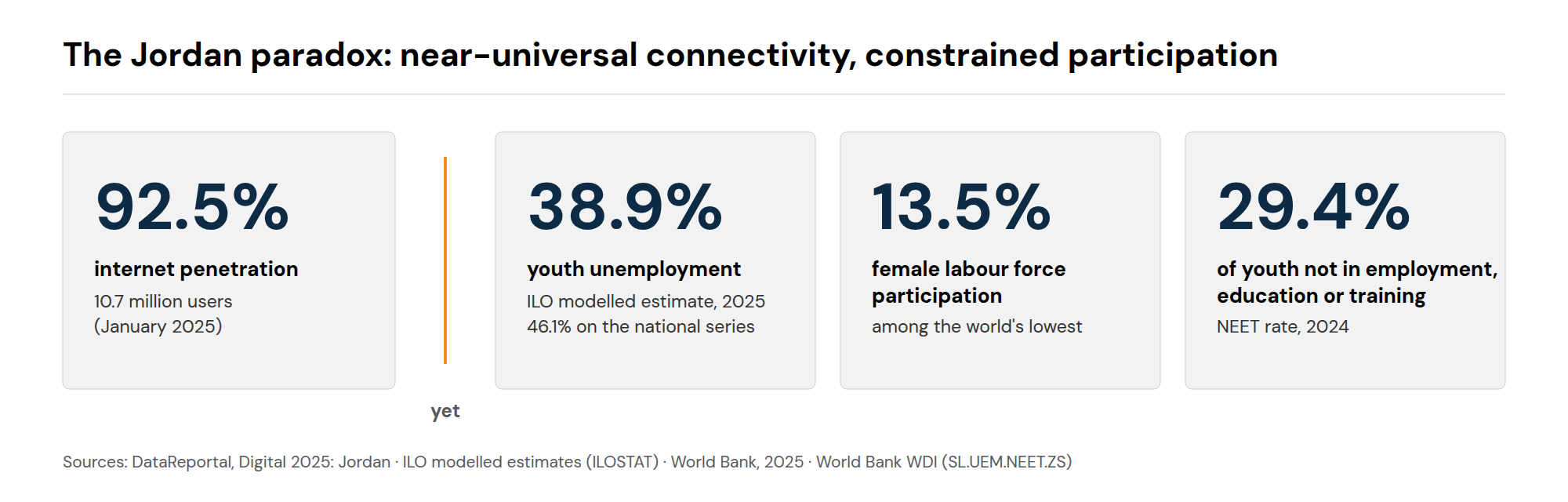
Jordan concentrates the regional paradox in one labour market. Internet penetration, as noted at the outset, is near-universal at 92.5 per cent. Yet youth unemployment stands at 38.9 per cent on the ILO's harmonised estimate for 2025 — 46.1 per cent on the national series covering Jordanian citizens (World Bank, 2025) — and female labour force participation, at 13.5 per cent, is among the lowest in the world. Nearly one in three young Jordanians is not in employment, education, or training (World Bank WDI, 2024).
Figure 2. Connectivity has not converted into participation: Jordan combines 92.5% internet penetration with one of the world's lowest female labour force participation rates. Sources: DataReportal, 2025; ILOSTAT; World Bank, 2024–25.
What makes Jordan's case analytically distinctive is that education does not resolve the problem. Unemployment among holders of a bachelor's degree or higher reached 25.8 per cent in 2024 (Jordan Times, reporting Department of Statistics annual data, 2025), and more than half of all unemployed Jordanians hold post-secondary qualifications (Jordan Department of Statistics, 2025). Jordan's constraint is not the supply of educated people; it is the conversion of education into economic participation.
The assets for digital conversion are unusually strong. Jordan's technology sector generates annual revenue exceeding US$3.3 billion across more than 1,000 companies, and the country produces 27 per cent of the region's technology entrepreneurs with roughly 3 per cent of its population (US International Trade Administration, 2026). National policy points the same way: the Economic Modernisation Vision targets growth in ICT employment from 24,700 to 101,000 full-time positions and digital exports rising from JD 0.2 billion to JD 4.5 billion by 2033 (Government of Jordan, 2022), and the Ministry of Digital Economy and Entrepreneurship operates Jordan Source to position the country as a regional supplier of digitally delivered services (Jordan Source).
Payment infrastructure tells a precise story. Domestically, Jordan's rails are scaling fast: CliQ instant payments grew 178 per cent in 2024 to 84 million transactions worth JOD 12.1 billion, and mobile wallet users reached 2.59 million — 48.8 per cent of them women (JoPACC, via TechAfrica News, 2025). Yet measured account ownership was essentially flat between 2021 and 2024 at 46.5 per cent, with a roughly 20-percentage-point gender gap (World Bank Global Findex, 2025). The rails exist and are improving; connecting new earners — especially women — to them is part of the livelihoods task itself. Jordan has the educated people, the connectivity, the sector base, and the policy direction. What the evidence says it has lacked is the infrastructure that converts learning into income.
Why skills programmes often fail to produce livelihoods
The instinctive policy response to youth unemployment — teach digital skills — has been evaluated extensively, and the results are sobering. A meta-analysis of more than 200 evaluations of active labour market programmes found average short-run employment effects close to zero, with meaningful gains appearing only two to three years after completion (Card, Kluve and Weber, 2018). Reviewing the developing-country evidence, McKenzie found that many rigorous evaluations detect no significant impact on either employment or earnings, and that government-run vocational programmes operating at scale typically raise employment by around two percentage points or less (McKenzie, 2017; VoxDev).
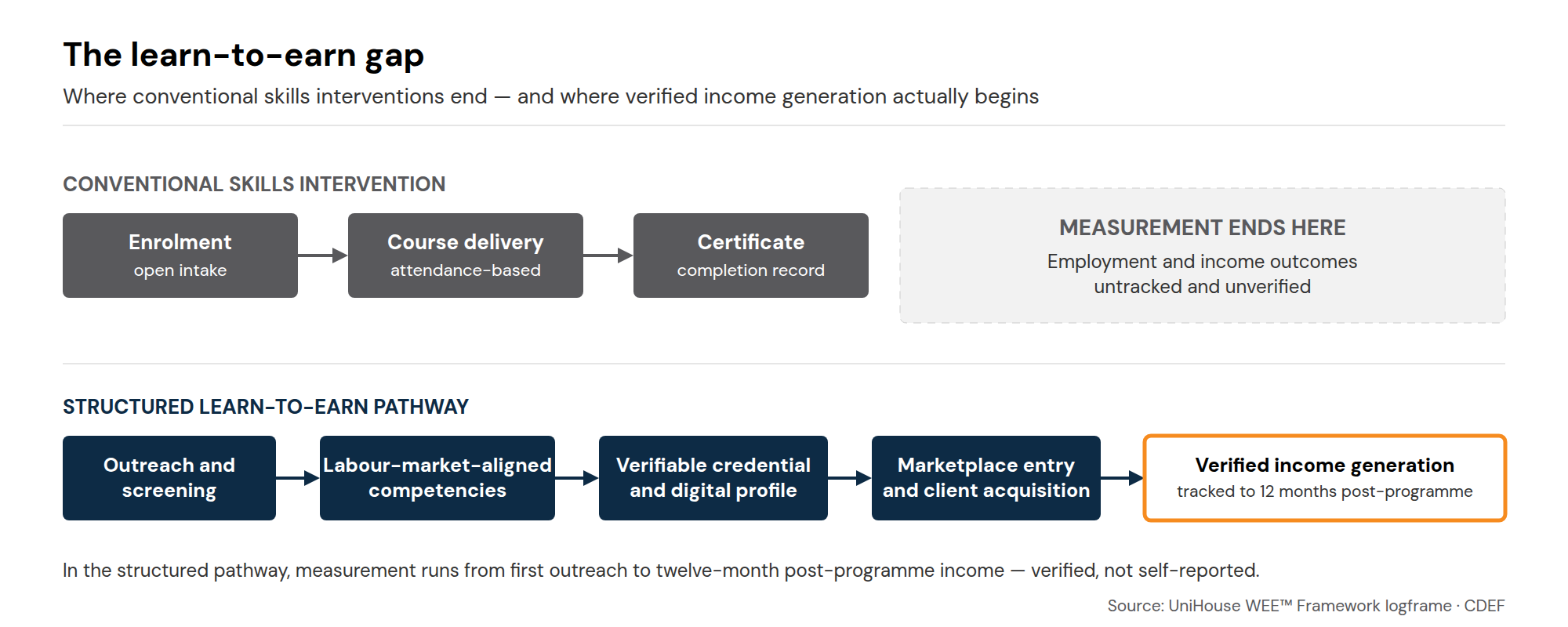
The evidence on digital jobs programmes specifically points to why. A World Bank Solutions for Youth Employment review of 19 programmes connecting youth — especially young women — to digital work found that outcomes were determined less by the technical content taught than by programme design: mentorship, placement mechanisms, and gender-intentional support structures (S4YE, 2018). Conventional programmes end at certification. The graduate holds a completion record no client can verify, no professional profile a buyer can find, no defined service or price, no first client, and — in much of the region — no account to be paid into. Each gap is individually mundane; together they explain why certificates so rarely become income.
Table 3. A skills programme and a digital livelihoods ecosystem are different interventions
| Dimension | Conventional skills programme | Digital livelihoods ecosystem |
|---|---|---|
| Objective | Deliver curriculum; issue certificates | Sustained, verified income generation |
| Endpoint | Course completion | Twelve-month post-programme income tracking |
| Selection | Open enrolment | Screening and segmentation against market demand |
| Credential | Certificate of completion | Verifiable competency credential a client can check |
| Market access | Left to the graduate | Professional profile, marketplace entry, client acquisition support |
| Payments | Out of scope | Supported bank and wallet mechanisms where available |
| Measurement | Attendance and completion, often self-reported | Digitally verified outcomes at every stage, gender-disaggregated |
Read the full analysis: Why Training Alone Fails — The Activation Framework
The missing infrastructure between learning and earning
Naming the barriers makes the required infrastructure legible. A new entrant to online work must be discoverable among millions of profiles; must carry a credential a stranger will trust; must define, price, and sell a service; and must reach a first client without a track record. The same entrant must then be paid across borders at acceptable cost, smooth volatile early income, differentiate from generative AI on the tasks AI now does cheaply, and sustain working conditions that do not erode the value of the income earned. None of these barriers is removed by a certificate.
Figure 3. Conventional skills interventions end measurement at certification. A structured learn-to-earn pathway extends delivery — and measurement — through marketplace entry to verified income. Source: UniHouse WEE™ Framework logframe.
Table 4. Barrier-to-response matrix
| Barrier | Required implementation response |
|---|---|
| Discoverability in a crowded global market | A professional digital profile with a unified, shareable URL, indexed for search |
| Credential credibility | Competency-verified certification a client can check, not an attendance record |
| First-client acquisition | Marketplace entry, service listings, initial promotion, mentorship, and internship routes |
| Service definition and pricing | Structured entrepreneurship readiness: defining, pricing, and positioning services |
| Payment access | Onboarding to supported bank and wallet mechanisms where available; local rails first |
| Income volatility at entry | Progression support toward repeat clients and, over time, sustained income |
| AI compression of routine tasks | Demand-led selection of occupations, refreshed each cohort cycle; AI tools embedded in delivery |
| Inclusion and protection | Gender-intentional design, refugee inclusion, and monitored working conditions |
This is infrastructure in the proper sense: a set of connected systems that individuals cannot efficiently build for themselves and that one-off projects cannot sustain. The question for Jordan is who builds and operates it — and whether it can be measured well enough for governments and development partners to fund it on results. It is to one such implementation that this article now turns.
Ostathi Jordan's digital livelihoods model
Ostathi Jordan is the national platform through which Jordanians move from learning into paid digital work — a digitally enabled livelihood activation and workforce participation ecosystem, and a national implementation of the infrastructure described above. It was developed and is operated by UniHouse, an international advisory firm established in 1999 that designs, delivers, and measures structured capacity development systems across the Middle East, Africa, and Central Asia. In Jordan, the platform is deployed with the Ministry of Digital Economy and Entrepreneurship (MoDEE) under the World Bank-supported Youth, Technology and Jobs programme (MoDEE; UniHouse, 2026). A marketplace is one component of the ecosystem — the point where services meet clients — but the model is better understood as four connected layers.
Mobilisation and intake
Participation begins with targeted digital outreach and funnel-based application systems designed to reach the populations national programmes prioritise — young people, women, and under-represented groups — rather than whoever finds a course page first. Applicants complete structured digital intake assessments, and eligibility screening, data segmentation, and cohort allocation match them to appropriate pathways. A reserve pool stands behind each cohort, so attrition is managed by replacement rather than accepted as loss. Campaign analytics give programme managers real-time visibility of reach, conversion, and cohort composition. Selection is systematic: applicants are screened against eligibility, readiness, and labour market alignment criteria.
Market-aligned capability development
Occupational and market analysis precedes content. Pathways in the Jordan deployment — Digital Marketing, Translation, Administrative Support, and Accounting, among others — are selected against demand evidence of the kind reviewed earlier in this article, and revisited as that evidence moves. Delivery is modular and accessible, combining live instruction with low-bandwidth materials; practical assignments simulate client work rather than examinations; domain-specific AI tool modules are embedded within relevant pathways, reflecting the platform-level evidence reviewed above that generative AI is compressing demand for routine tasks while rewarding workers who use AI tools within higher-value services; and client-facing capabilities — communication, scoping, delivery discipline — are developed alongside technical competencies. Progression is certified against assessed competency thresholds, not attendance.
Workforce activation
Between certification and income sits the activation layer most programmes omit. Participants define and price professional services; receive verifiable credentials; and activate a professional digital profile with a unified URL — a single, shareable, search-discoverable professional identity that carries their certification, portfolio, and service offering. Mentorship pairs participants with experienced professionals; internship pathways provide structured first engagements; and freelancing and remote-work readiness — proposals, platforms, client etiquette — completes the transition from learner to market-ready service provider.
Economic participation
The final layer connects activated participants to local and international clients through the marketplace component and supports the earliest, most fragile phase of income generation: first client, first payment, first repeat engagement. Payments run through supported bank and wallet mechanisms where available — a design choice that matters in a market where instant domestic payments are scaling rapidly while conventional account ownership remains low. Engagement and outcomes are tracked continuously, and participants are supported toward repeat clients and income growth. The model does not guarantee employment or income — no credible programme can — but it structures, supports, and measures every step of the pathway toward them.
WEE™: a structured implementation pathway
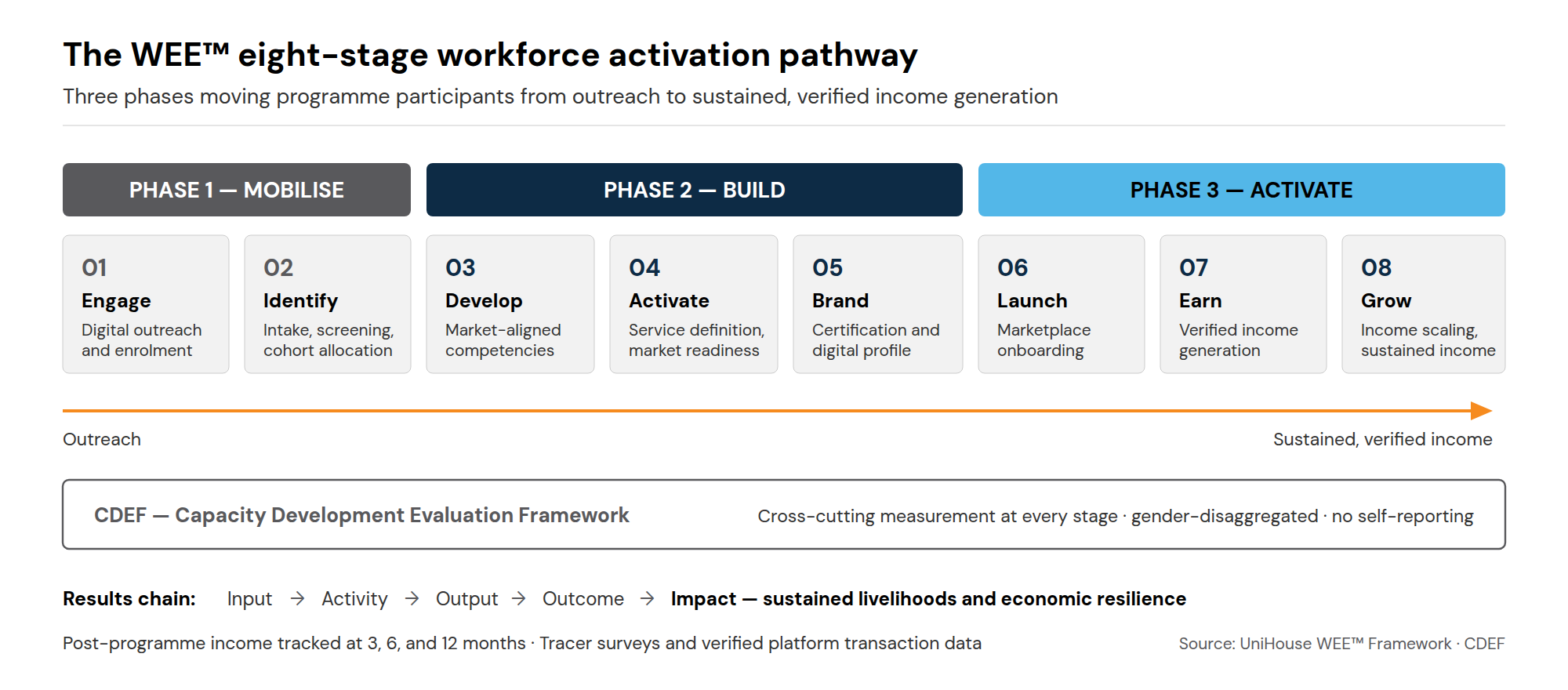
The operating model is governed by a defined methodology. The Workforce and Entrepreneurship Engine (WEE™) is UniHouse's structured implementation framework for moving participants from outreach and identification through capability development, professional activation, and market participation to income engagement and longer-term growth (Ostathi). It is organised in three phases and eight stages: Mobilise (Engage, Identify), Build (Develop, Activate, Brand), and Activate (Launch, Earn, Grow). Each stage carries defined outputs and indicators and feeds the next, so that a participant's progress — and a programme's performance — can be located precisely at any moment.
Figure 4. The WEE™ eight-stage pathway: three phases from outreach to sustained income, with measurement cross-cutting every stage. Source: UniHouse.
CDEF™: measuring progression and outcomes
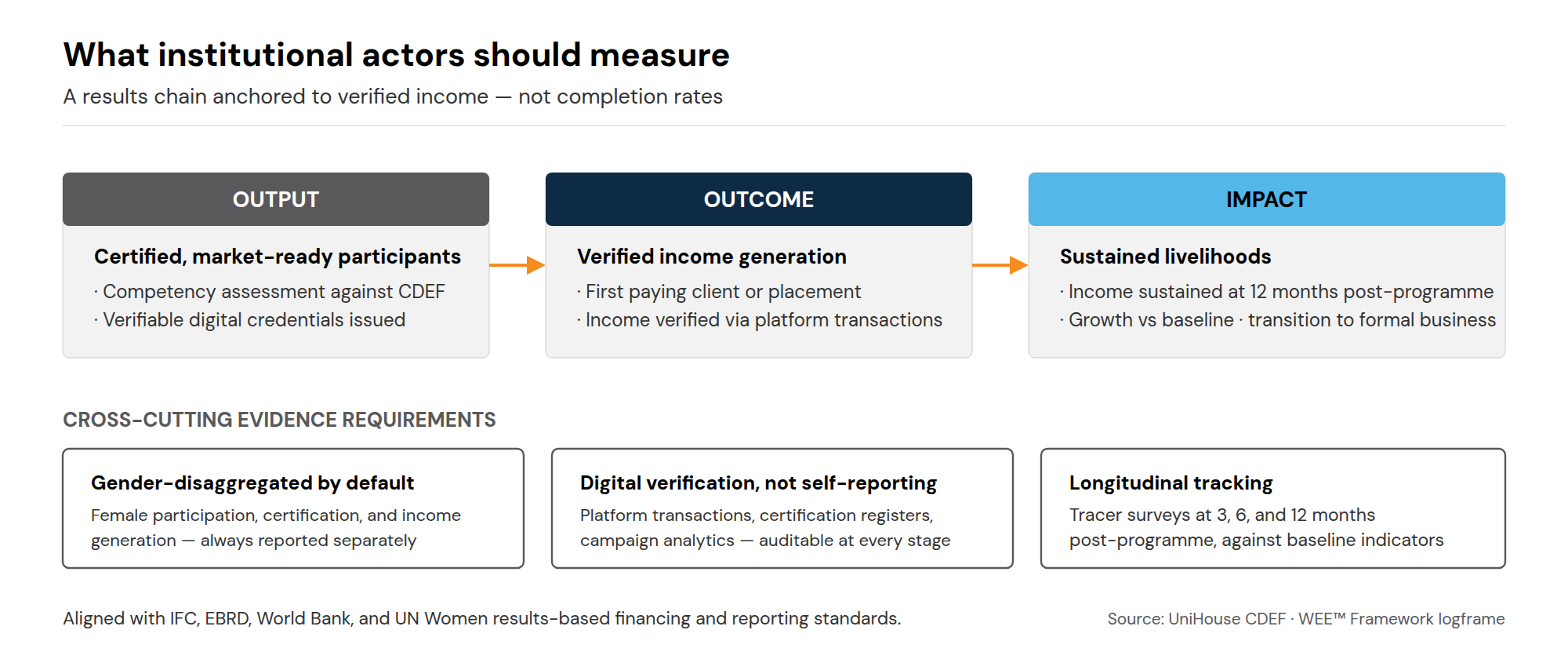
Cross-cutting the eight stages is the Capacity Development Evaluation Framework (CDEF™), the monitoring, evaluation, learning, and verification architecture that makes the pathway auditable. CDEF™ captures baseline and participant data at intake; tracks competency progression, participation, completion, and retention; records mentorship and internship engagement; verifies professional activation and workforce outcomes; and follows participants after exit, with income tracked at three, six, and twelve months post-programme. All indicators are disaggregated by gender as a minimum requirement — and by location and displacement status where relevant — and means of verification are digital and systematic: platform transaction records, certification registers, and campaign analytics rather than self-reported questionnaires. The same data supports adaptive management, allowing outreach, content, and activation support to be adjusted while a programme runs rather than evaluated after it ends.
Figure 5. A results chain anchored to verified income: gender-disaggregated by default, digitally verified, tracked longitudinally — aligned with IFC, EBRD, World Bank, and UN Women results-based financing and reporting standards. Source: UniHouse CDEF™.
Evidence from the current Jordan implementation
The institutional context is the World Bank-financed Youth, Technology and Jobs project — US$200 million (a US$163.1 million IBRD loan and a US$36.9 million Global Concessional Financing Facility grant), approved in March 2020 and closing in February 2027, implemented by MoDEE (World Bank, P170669). Its development objective is to "improve digitally-enabled income opportunities and expand digitized government services in Jordan” (World Bank PAD, 2020). Its contractual end-targets — targets, not yet results — include 10,000 beneficiaries reporting new income opportunities, of whom 30 per cent women and 15 per cent Syrian refugees.
Implementation reporting shows the YTJ project operating at national scale. As of the World Bank's implementation status report of November 2025, 7,999 individuals had completed digital-economy programmes under the project — 4,523 of them women, a 57 per cent share — and 4,310 verified digital income opportunities had been recorded, alongside digital-skills curriculum reaching over 400,000 public-school students (World Bank ISR, 2025). Within this project ecosystem, UniHouse was engaged by MoDEE in 2026 to deliver national implementation of the WEE™ framework through Ostathi Jordan (UniHouse, 2026).
The earliest implementation evidence from that engagement concerns the mobilisation layer: on activating targeted outreach and the funnel-based intake system, the programme received more than 1,000 applications within the first five days (Ostathi, 2026). Application volume is an intake result, not an income outcome — but it tests the specific claim that structured digital mobilisation can generate applicant volume in Jordan quickly, and it produced the screened, segmented cohorts now moving through the Build phase. Income-stage results will be reported through CDEF™ tracking as cohorts reach the Earn and Grow stages; consistent with the measurement discipline this article has argued for, they will be published as verified figures with dates, not projections.
Jordan implementation evidence — status summary
| Institutional context | World Bank Youth, Technology and Jobs project (P170669), US$200m, implemented by MoDEE; closing February 2027 |
| Project development objective | "Improve digitally-enabled income opportunities and expand digitized government services in Jordan” (PAD, 2020) |
| Contractual end-targets | 10,000 beneficiaries reporting new income opportunities; 30% women; 15% Syrian refugees (targets) |
| Reported to date
As of November 2025, World Bank ISR |
7,999 trained (4,523 women — 57%); 4,310 verified digital income opportunities; 402,757 students reached |
| Ostathi Jordan mobilisation
2026 |
1,000+ applications within five days of activating targeted outreach and intake |
| Ongoing | Cohorts progressing through Build and Activate phases; CDEF™ tracking to 12 months post-programme |
Professional identity, verification, and discoverability
One element of the model deserves separate analytical attention, because the AI-era evidence makes it decisive. When generative tools can produce plausible text, code, and design at near-zero cost, what a client cannot generate is confidence in a person: verified competency, a checkable track record, and a professional identity that persists across engagements. The model treats these as infrastructure. Certification is competency-verified; the professional profile consolidates credentials, portfolio, and services at a unified URL a client — or a search engine — can find; and income is verified through platform transaction data rather than asserted (Ostathi, 2026). Verification serves both sides of the model at once: it is the worker's market differentiator, and it is the programme's evidence base. The same transaction record that wins a participant their next client gives a ministry or development partner an auditable outcome.
Responsible and inclusive digital livelihoods
An evidence-led treatment of digital livelihoods must be honest about their risks. Online work at the entry level is volatile and internationally competitive — as noted above, half of online platform workers globally earn under US$2 per hour; platform fees and payout costs erode small earnings; and the working conditions of platform work are, as noted, the subject of an active ILO standard-setting process. Generative AI is narrowing the routine tasks through which beginners have traditionally entered.
These risks are design inputs, not afterthoughts. Screening and demand-led selection direct participants toward defensible, demanded services rather than saturated microtasks; activation support and mentorship shorten the volatile entry phase; payment onboarding connects new earners to formal financial rails — a channel where women are already well represented, holding 48.8 per cent of Jordan's mobile wallets against 36.2 per cent account ownership; and longitudinal tracking makes income quality, not just income incidence, observable. Inclusion is engineered in the same way: gender-disaggregated measurement is a minimum requirement at every stage, outreach is designed for under-represented groups, and the female share of participants reported under YTJ as of the World Bank's November 2025 implementation status report — 57 per cent of those trained — indicates what gender-intentional programme design can achieve in a market where female labour force participation is 13.5 per cent. Regional precedent extends the logic to refugees: the World Bank documents e-wallet onboarding used to bring displaced populations without bank accounts into digital work in Jordan (World Bank, 2024), and refugee inclusion is an explicit YTJ target.
Implications for governments and development partners
For institutions that fund employment outcomes, the evidence reviewed here converges on a small number of design principles. The consistent finding — from the ALMP meta-analyses to the digital jobs case literature — is that the binding constraint is not curriculum but conversion; funding should therefore buy pathways, not courses. Where outcomes can be digitally verified, they should be: self-reported employment is the weakest data in the results chain, and platform-verified income is among the strongest. Measurement should be disaggregated and longitudinal by default, because averages taken at completion conceal exactly the attrition and gender gaps that determine whether a programme worked. Payment access belongs inside programme scope, not outside it. And occupational selection must be dynamic, because generative AI is repricing entry-level digital tasks faster than programme cycles.
| Five design principles for digitally enabled employment programmes | |
|---|---|
| 1. Fund pathways, not courses | Contract delivery through to market entry and income, with stage-gated indicators from outreach to post-programme tracking |
| 2. Anchor on verified income | Use platform transaction data and verifiable credentials as primary outcome evidence; avoid self-reporting |
| 3. Disaggregate and follow up | Gender-disaggregated indicators at every stage; tracer measurement at 3, 6, and 12 months post-programme |
| 4. Put payment access in scope | Onboard participants to bank and wallet rails as a programme output, with cross-border payout constraints addressed explicitly |
| 5. Select occupations dynamically | Re-run market and AI-exposure analysis each cohort cycle; embed AI tools within capability development |
Conclusion: from digital training to economic participation
The global digital labour market is large, growing, measurable, and — for the educated, connected, underemployed young populations of the Middle East — genuinely accessible. The evidence is equally clear that access is not conversion: certificates alone do not produce livelihoods, and unstructured exposure to platform work can entrench precarity rather than resolve it. What converts learning into income is infrastructure — mobilisation that reaches the right people, capability development aligned to what markets actually buy, activation that makes new professionals credible and discoverable, payment rails they can be paid through, and measurement that verifies rather than asserts the result.
Jordan is a demanding and therefore instructive place to build that infrastructure: a labour market where education has outrun employment, inside a national digital-economy programme with the explicit objective of improving digitally enabled income opportunities. Ostathi Jordan — a locally grounded digital livelihoods ecosystem, developed and operated by UniHouse and deployed with MoDEE under the World Bank-supported Youth, Technology and Jobs programme — is a developing reference model for that conversion: structured by WEE™, verified by CDEF™, and accountable to the same standard this article has applied throughout. Its results will be reported as they are earned — dated, disaggregated, and verified.
Related analysis: Digital Livelihoods in Iraq: The Next Frontier of the Learn-to-Earn Transition — the second country study in this series.
Related analysis: Digital Livelihoods in Morocco — A Producing Economy Missing Its Platform Layer, fourth in this series.
Frequently asked questions
What are digital livelihoods?
Digital livelihoods are sustained, verifiable incomes earned through digitally enabled work — online freelancing, remote employment, digitally delivered professional services, platform-mediated work, or digital entrepreneurship. The World Bank estimates 154–435 million people — between 4.4 and 12.5 per cent of the global labour force — already earn through online gig work.
How is a digital livelihood different from completing a digital course?
A course produces a certificate; a livelihood requires market-relevant competencies, a verifiable credential, a discoverable professional profile, clients, payment channels, and income that continues over time. Evaluations show government training programmes operating at scale raise employment by only around two percentage points or less — which is why structured pathways extend through market entry to verified income.
Which digital occupations are realistically accessible in Jordan?
Occupations are selected from market analysis rather than assumed. Current pathways in the Jordan deployment include digital marketing, translation, administrative support, and accounting — bilingual, service-based occupations where Jordan's educated workforce is competitive and where demand evidence is strong. Selection is refreshed as market and AI-exposure evidence moves.
What is the WEE™ framework?
The Workforce and Entrepreneurship Engine (WEE™) is UniHouse's eight-stage implementation framework moving participants from outreach to sustained income across three phases — Mobilise (Engage, Identify), Build (Develop, Activate, Brand), and Activate (Launch, Earn, Grow) — with the CDEF™ evaluation framework measuring every stage.
How does Ostathi Jordan verify income outcomes?
Through digital means of verification rather than self-reporting: platform transaction records, certification registers, and campaign analytics, with post-programme income tracked at three, six, and twelve months and all indicators disaggregated by gender as a minimum requirement.
How does the model include women and refugees?
Inclusion is designed in at every stage: outreach targeted to under-represented groups, gender-disaggregated measurement throughout, flexible remote participation, and payment onboarding. Under Jordan's Youth, Technology and Jobs programme, women were 57 per cent of participants trained, as reported in the World Bank's implementation status report of November 2025; separately, the project's end-targets specify 30 per cent women and 15 per cent Syrian refugees among those reporting new income opportunities.
Editorial Note
This article forms part of the Ostathi Digital Livelihoods Insight Series, a long-term research initiative examining workforce transformation, digital livelihoods, skills ecosystems and the future of work across Jordan, the Middle East and internationally. Articles in this series are updated periodically to reflect new evidence, policy developments and implementation insights.
About the Authors
Aows Dargazali
Director – Development & Capacity Building Programmes, UniHouse Global | Founder of Ostathi
Aows Dargazali is an international workforce development and digital economy specialist with more than 25 years of experience designing and implementing capacity-building, digital livelihoods, workforce activation and organisational development programmes across the Middle East, Africa and Central Asia. He leads the development of the Workforce and Entrepreneurship Engine (WEE™) and the Capacity Development Evaluation Framework (CDEF™), supporting governments, development finance institutions and international organisations in designing evidence-based pathways from learning to verified economic participation.
Wafa Aladwan
Managing Director, UniHouse Jordan
Wafa Aladwan leads UniHouse Jordan's national operations and the implementation of workforce development, digital livelihoods and capacity-building programmes delivered in partnership with government institutions, international organisations and development partners. She has extensive experience managing complex national initiatives that strengthen skills development, employment pathways and digital economy participation, with a particular focus on programme implementation, stakeholder engagement and measurable development outcomes.
References
View full reference list
Card, D., Kluve, J. and Weber, A. (2018). What Works? A Meta-Analysis of Recent Active Labor Market Program Evaluations. Journal of the European Economic Association 16(3) / NBER Working Paper 21431.View source. Accessed 13 July 2026.
DataReportal / Kepios (2025). Digital 2025: Jordan. February 2025.View source. Accessed 13 July 2026.
Demirci, O., Hannane, J. and Zhu, X. (2023). Who Is AI Replacing? The Impact of Generative AI on Online Freelancing Platforms. SSRN; published in Management Science (2024).View source. Accessed 13 July 2026.
Government of Jordan (2022). Economic Modernisation Vision.View source. Accessed 13 July 2026.
GSMA (2025). The Mobile Economy: Middle East and North Africa 2025. November 2025.View source. Accessed 13 July 2026.
Hui, X., Reshef, O. and Zhou, L. (2023). Artificial intelligence and its short-term effects on employment. CEPR/VoxEU, December 2023; published in Organization Science.View source. Accessed 13 July 2026.
ILO (2021). World Employment and Social Outlook 2021: The role of digital labour platforms in transforming the world of work.View source. Accessed 13 July 2026.
ILO (2023). Gmyrek, P., Berg, J. and Bescond, D. Generative AI and Jobs: A global analysis of potential effects on job quantity and quality. ILO Working Paper 96.View source. Accessed 13 July 2026.
ILO (2024). Global Employment Trends for Youth 2024 (report and regional brief for the Arab States and North Africa). August 2024.View source. Accessed 13 July 2026.
ILOSTAT. ILO modelled estimates database (youth unemployment; labour force participation).View source. Accessed 13 July 2026.
ILO (2024). Realizing Decent Work in the Platform Economy. Report V(1), 113th International Labour Conference.View source. Accessed 13 July 2026.
ILO (2025). World Employment and Social Outlook: Trends 2025. January 2025.View source. Accessed 13 July 2026.
ILO (2025). Gmyrek, P. et al. Generative AI and Jobs: A Refined Global Index of Occupational Exposure. ILO Working Paper 140, May 2025.View source. Accessed 13 July 2026.
ILO (2026). Employment and Social Trends 2026. January 2026.View source. Accessed 13 July 2026.
IMF (2024). Cazzaniga, M. et al. Gen-AI: Artificial Intelligence and the Future of Work. IMF Staff Discussion Note SDN/2024/001, January 2024.View source. Accessed 13 July 2026.
ITU (2025). Measuring digital development: Facts and Figures 2025 — Internet use. October 2025.View source. Accessed 13 July 2026.
Jordan Department of Statistics (2025). Unemployment Rate — Q3 2025 press release.View source. Accessed 13 July 2026.
Jordan Source / MoDEE. About Jordan Source.View source. Accessed 13 July 2026.
Jordan Times (2025). Jordan's unemployment rate drops to 21.4% in 2024, gender gap persists. March 2025.View source. Accessed 13 July 2026.
JoPACC (2025). 2024 Payment Systems Report, as reported by TechAfrica News, April 2025.View source. Accessed 13 July 2026.
McKenzie, D. (2017). How Effective Are Active Labor Market Policies in Developing Countries? A Critical Review of Recent Evidence. World Bank Research Observer 32(2).View source. Accessed 13 July 2026.
MoDEE. Youth, Technology and Jobs Project.View source. Accessed 13 July 2026.
OECD, ILO and European Commission (2023). Handbook on Measuring Digital Platform Employment and Work.View source. Accessed 13 July 2026.
Oxford Internet Institute. The iLabour Project and Online Labour Index.View source. Accessed 13 July 2026.
Petra — Jordan News Agency (2026). Jordan Chamber of Commerce, int@j to boost ICT sector expansion into Saudi Arabia, Syria and Iraq. February 2026.View source. Accessed 13 July 2026.
S4YE / World Bank (2018). Digital Jobs for Youth: Young Women in the Digital Economy.View source. Accessed 13 July 2026.
UNESCO. World Arabic Language Day.View source. Accessed 13 July 2026.
UniHouse (2026). UniHouse awarded MoDEE engagement to deliver national WEE framework implementation in Jordan. April 2026.View source. Accessed 13 July 2026.
US International Trade Administration (2026). Jordan — Information and Communication Technology. Country Commercial Guide, February 2026.View source. Accessed 13 July 2026.
VoxDev. McKenzie, D. Reexamining whether, when, and how developing country governments should provide training.View source. Accessed 13 July 2026.
W3Techs (2026). Usage statistics of Arabic for websites.View source. Accessed 13 July 2026.
World Bank (2020). Jordan Youth, Technology and Jobs Project — Project Appraisal Document.View source. Accessed 13 July 2026.
World Bank (2023). Working Without Borders: The Promise and Peril of Online Gig Work.View source. Accessed 13 July 2026.
World Bank (2024). Working Without Borders — companion note on payments and platform constraints.View source. Accessed 13 July 2026.
World Bank (2025). Global Findex Database 2025. July 2025.View source. Accessed 13 July 2026.
World Bank (2025). On the Job: Expanding Economic Opportunities for Youth, Women, and Refugees in Jordan. Results brief, April 2025.View source. Accessed 13 July 2026.
World Bank (2025). Youth, Technology and Jobs Project (P170669) — Implementation Status and Results Report. November 2025.View source. Accessed 13 July 2026.
World Bank (2025). Digital Progress and Trends Report 2025: Strengthening AI Foundations. November 2025.View source. Accessed 13 July 2026.